

Spirituality, values & attitude
Cistercian spirituality
Origins
The Cistercian Order belongs to the Benedictine family. Benedict of Nursia (c. 480–547) is the founder of Western monasticism. The Cistercians emerged in 1098 as a reform movement of Benedictine monasticism in France (first monastery in Cîteaux). Bernard of Clairvaux (c. 1090–1153) was not the founder, but he was the most important inspiration and driving force at the beginning.
Spread
The order quickly spread throughout Europe, enabling Wilhering Abbey to be founded in 1146 during St. Bernard's lifetime. Today, there are around 2,500 Cistercian monks and nuns living in over 160 monasteries worldwide. The order has a particularly large number of members in Vietnam. The Austrian Cistercian Congregation includes the abbeys of Rein, Heiligenkreuz, Zwettl, Lilienfeld, Wilhering and Schlierbach in Austria, as well as Hohenfurth in South Bohemia.
Life
Cistercian spirituality is based on the Gospel of Jesus Christ, the Rule of St. Benedict and the mystical writings of the early fathers and mothers of the order, with particular reference to the spiritual writings of Bernard of Clairvaux. The aim of monastic life is to seek and find God through the monastic vocation.
Life in the monastery should form a unity of prayer, community life and work, which are interdependent and mutually enriching. The concrete form of life varies greatly from monastery to monastery. Cistercians are active in education, pastoral care and individual accompaniment of people.
Pilgrimage routes
As stops on pilgrimage routes, monasteries have always had a special significance. In Wilhering, the new pilgrimage route converges with the Way of St James, the Jerusalem Way and the Benedict Way.
At a time when church life is disappearing in some places and at the same time there is a noticeable longing for a new spiritual anchorage, monasteries are reliable places of prayer, worship and church community.
Abt Reinhold Dessl OCist
The spirituality of pilgrimage
„Spirituality is the art of movement – it depends on the spirit that moves me.“
( P. Dr. Johannes Pausch, European Monastery Gut Aich)
Human beings are pilgrims from the very beginning of their journey through life.
The root word of pilgrimage comes from ‘peregrinatio’ and means to leave one's own field, to become free from ties and dependencies. It also means to be a stranger in a foreign land and to explore the foreign within oneself in an external foreign environment, to become friends with one's own foreignness.
Pilgrimage is an exploration of the path to oneself, to fellow human beings, to the environment and to God.
Those who embark on a pilgrimage set out on a journey that leads them away from their familiar surroundings, their own home, village or town. This can help them to gain some distance from everyday life and see their own lives more clearly again; to see what they are grateful for, what makes them happy, where life is going well or what is weighing them down, what their deepest longings are.
Pilgrimage is not a fun activity, but rather a clear focus on creation and thus on God.
Pilgrimage is characterised by a structure:
Setting off – Being on the move / Walking / Resting – Arriving – Being present – ‘If you want to walk a thousand miles, you must start with the first step’ (Chinese proverb).
It takes courage to take the first step (setting off), strength to persevere (walking, being on the move) and blessing to reach your destination (arriving).
The path
However, this does not refer to the mapable, visible, objective path, but rather to people being on the move, travelling towards a destination, sometimes alone, sometimes together with other people and with God.
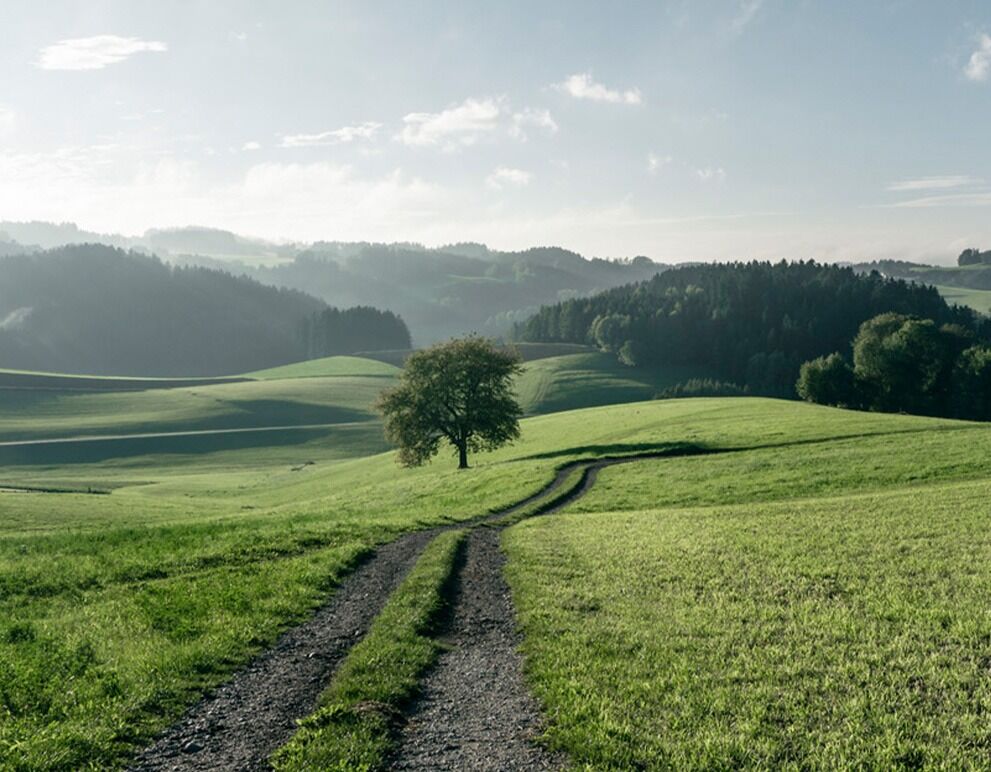
The path is therefore a symbol of human journeying and, in pilgrimage, a symbol of life: straight paths, winding paths, restful paths, arduous paths, stony paths, soft paths, detours, wrong turns, short paths, long paths, endless paths, crossroads, dry spells, walking together, communities of travellers.
The path is a primal symbol of life. We are on a journey to ourselves, to each other and to the meaning of our lives – to God / to the divine / to salvation.
The word “meaning” originally meant “to go”, “to travel”, to gain experience, to go deep, to go to the source, to experience something.
Life is a long pilgrimage to oneself. Finding one's identity is a lifelong process, a path with different stages, a task.
On this path, we encounter God (especially at the crossroads).
When pilgrimaging, people become aware that they leave traces behind, follow in the footsteps of others, are sometimes thrown off their own path, and that they set the pace for others. If the path is difficult at the beginning, one should not abandon it immediately; if one continues along it, it leads to the vastness, to the fullness of wholeness. Every little sign along the way is fulfilling. Consciously observing the path of life, having time, taking time to live, for one's own path in life.
When pilgrimaging, one experiences that everyone is allowed/must go their own way, that everyone is allowed/must choose their own path (actively walking on their own two feet).
We are physical, sensual beings; all experience and knowledge is conveyed through the senses. Pilgrimage offers many experiences along the way.
On the way, there are many encounters with other people.
M. Buber says: ‘Through you, man becomes I’.
Fellow travellers encourage pilgrims to be mindful and to walk together and for each other.
The path as a microcosm of life has various aspects and stages that correspond to the phases of pilgrimage:
Setting off
Setting out, in contrast to ‘sitting together’, is the danger of remaining seated and thus not being in a state of inner movement and therefore development.
Setting out, opening up, letting go, facing challenges.
Pilgrimage means setting out on new experiences, facing life, opening up, allowing an inner journey of transformation.
Setting out means facing the challenge of unfamiliar walking;
physical exercise; a new environment – nature; giving up comfort; and silence; leaving something behind and opening up to something new.
Unusual situations are opportunities for change – the words “path” and “change” have the same root. Today, we need a new beginning that gives us hope for our lives, a new beginning with new opportunities for coexistence and a new way of dealing with creation, leading us to new shores.
Setting out means leaving your comfort zone (positive asceticism), giving up convenience and consumption opens up new experiences: appreciating the simple things and being grateful (dry clothes, a warm drink, fresh water, a kind word, a rest and a break).
Questions of reflection arise:
What do I want to leave behind?
Luggage – what and how much am I carrying with me? – What can I remove from my life's backpack; what am I consciously putting in it because I am missing it?
What do I want to take with me? What do I actually need?
What question, what life issue accompanies me? Who accompanies me?
The modern shift in values and the trend towards pilgrimage are linked. Many people are no longer just looking for consumerism and wellness fun, but for meaning and holistic healing. Grappling with fundamental questions about life, searching for meaning and longing for an encounter with God are leading many people to set out on pilgrimage.
Setting out means both leaving and leaving something behind.
A change of location means entering a world that is the opposite of the familiar everyday or professional world. Motivation draws us out into the wide world, leaving/going away in order to be able to accept, retreating from everyday life in order to find orientation.
Being on the move / Walking
Walking is in our genes and part of our nature; a lack of exercise makes us ill in body and soul... Words such as “stuck”, “immobile”, “stuck”, “frozen”, etc. express this.
Physical and mental movement are connected. What steps do I take: big steps, small steps, firm steps, hesitant steps, gentle steps, fast steps, slow steps...
Walking for long periods of time, such as on a pilgrimage, i.e. constantly being physically
‘in motion’, also sets the soul in motion. You feel yourself holistically.
Walking in its uniformity is supported by regular conscious breathing and becomes meditation. Questions and problems arise and can be considered. Solutions mature, partly because familiar everyday behaviour patterns are called into question.
The sense of time changes; one succeeds in being completely in the moment, having time and savouring it.
The healing effects of nature with its colours, smells, images, sounds, weather, times of day and seasons accompany pilgrims to a new sensitivity, mindfulness and spirituality.
When travelling, one always encounters places of encounter – being accepted, being welcomed = places of lived hospitality: not because I pay, but because I am ME.
Rest/Relaxation
The steady rhythm of walking leads to inner peace, to the discovery of slowness, which makes it possible to perceive more consciously, to study the landscape with your feet, to caress the ground with your feet.
Rest cannot be forced. The beauty of creation, which can now be enjoyed, is a gift to pilgrims. Having time, not having to do anything, not having to perform, just BEING. Having leisure time to perceive with all your senses is a privilege.
„Wahrnehmung“ der Natur mit allen Sinnen und „Besinnung“ hängt zusammen und ist eine
Erfahrung der Lebendigkeit – alles ist belebt (Mikrokosmos).
Zusammenhang und Vernetztheit werden bewusst: auch ICH bin ein Teil davon, verbunden mit ALLEM.
Ruhe ermöglicht es bewusst zu genießen und zu danken
Arrival - Destination
Arriving, looking back, celebrating.
The goal has been reached – reaching it means: it's enough, I don't need to go any further, carry on, it's good as it is. A deep sense of satisfaction sets in: I've done it! I'm here. I've arrived at myself, at others, at God. I set out so that his message could reach me.
Arriving – reaching the goal – stands for hope for the future, God as the goal of the journey.
Existence
Looking back, I see that I have learned my abilities and limitations, gained external and internal strength, grown, and been encouraged and strengthened by the distance I have travelled. I have been given self-confidence and trust in God.
Pilgrimage has a deep spiritual aspect. We are wanderers on earth and spend our lives searching for salvation and happiness, feeling alienated from it time and again, seeking our inner home and finding it – ultimately in God.
Christine Dittlbacher MAS